
Why We Can’t Let Go
There is a specific kind of magic found in the dust of an attic or the corner of a local estate sale. You move a stack of old blankets and discover it: a forgotten archtop jazz guitar, a 1962 Fender Stratocaster, or perhaps a 1959 Gibson Les Paul, silent for decades. Finding a piece of musical archaeology is a thrill, but it carries a heavy responsibility. As a luthier, I see these “closet finds” often, and while the urge to polish away every year of grime is strong, the path to truly reviving a vintage beauty is paved with restraint. This guide is for those who want to breathe new life into a treasure without accidentally stripping away the very history that makes it valuable.
1. The Counter-Intuitive Truth About Refinishing
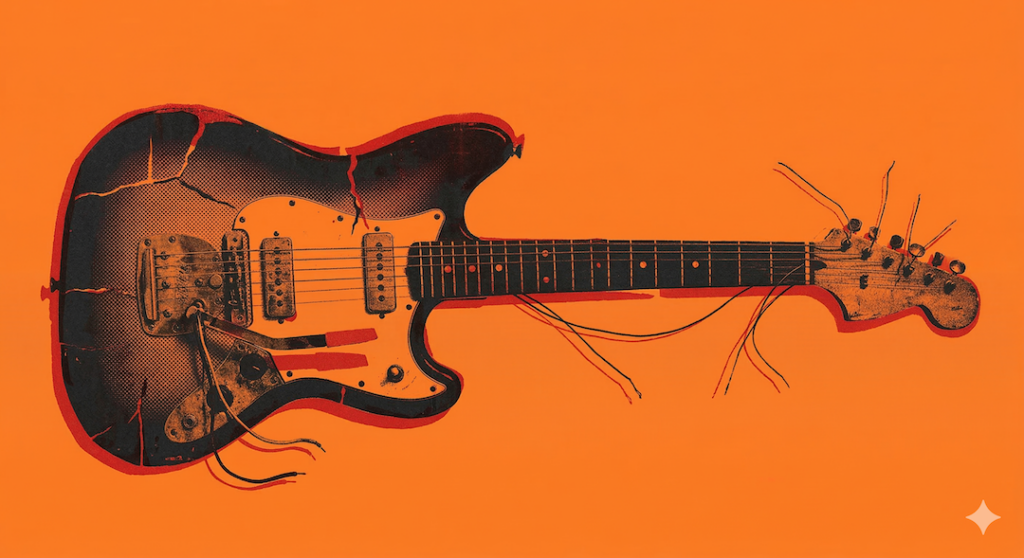
When you first acquire a guitar that has seen better days, your instinct might be to sand it down and give it a fresh coat of paint. In the world of vintage restoration, this is rarely advisable because a full refinish can devalue an instrument significantly and diminish its unique character. Every scratch and “checking” in the lacquer is a part of the guitar’s story, contributing to its charm and historical value. For instruments with traditional nitrocellulose finishes, the aging process actually allows the wood to breathe and vibrate more freely.
Cleaning should be your first and simplest step, but it must be done with extreme care to avoid damaging the original chemistry of the instrument. Use only a soft, lint-free cloth and specialized cleaners that are verified as safe for sensitive vintage lacquers.
“It’s important to never use products not specifically designed for guitar use.”
Refinishing is an advanced step that often causes more harm than good to the instrument’s soul. Unless the finish is peeling to the point of structural danger, embrace the patina as a badge of honor.
2. The “50% Rule” of Professional Setups
Restoration isn’t just about how an instrument looks; it’s about the technical and “experience” parts of craftsmanship that make a guitar inspiring rather than unplayable. A proper professional setup can make a guitar 50% easier to play by transforming the physical relationship between the player and the strings. When an instrument is calibrated correctly, it ceases to be a struggle and becomes a responsive extension of the musician.
A comprehensive setup focuses on three core components:
- Action: Adjusting the height of the strings from the fretboard to ensure comfort without sacrificing tone.
- Intonation: Ensuring the guitar plays in tune across the entire length of the neck so chords ring true at every fret.
- Neck Relief: Adjusting the “bow” of the neck via the truss rod to provide the necessary clearance for string vibration.
3. Aged Wood as a Non-Replicable Resource
Generally, a guitar is considered vintage once it reaches at least 25 years of age, a threshold where the wood has undergone a biological “seasoning.” This process means the resins within the seasoned mahogany or spruce have hardened, and the wood has literally “learned” to vibrate over decades of play. Modern, factory-fresh guitars simply cannot replicate this tonal depth. This is why a 1958 Gibson Les Paul, with its solid mahogany body, carved maple top, and rosewood fretboard, possesses a voice that is fundamentally different from a new build.
| Wood Type | Tonal Impact |
| Mahogany | Yields a warm, rich, and deep tone. |
| Maple | Offers a brighter, more resonant sound. |
Choosing to preserve these original materials is vital because the art and science of lutherie rely on the unique acoustic properties of these aged biological structures.
4. The Precision of Structural Stewardship
Before you worry about the shine of the lacquer, you must address the “bones” of the guitar. Structural repairs, such as stabilizing cracks in the wood or fixing a loose neck joint, must take precedence over any cosmetic work. Poorly executed modifications are often irreversible and can destroy the historical integrity of a museum-quality piece. While simple cleaning is for everyone, structural work involving wood glue and clamps should only be handled by practiced technicians to ensure the repair lasts for the rest of the instrument’s life.
To perform these delicate operations, a luthier relies on a specific set of Essential Tools for the Trade:
- Wood Chisels and Hand Planes: For precise shaping and carving of replacement components.
- Finger Planes and Rasps: For fine-tuning the delicate curves of the neck and body.
- Nut Slotting Files: For detailed adjustment of string spacing and height at the headstock.
- Fretwork Tools: To level, crown, and dress worn or corroded frets.
5. The Hidden Impact of the “Nut and Saddle”
It is often the smallest technical adjustments that create the most profound functional differences in how a guitar feels and sounds. The nut and the saddle are the primary contact points for the strings; if they are worn or made of poor material, the entire voice of the instrument suffers. Even a minor truss rod adjustment is a game of millimeters. A 1/16-inch change in string height is the difference between a clean, ringing note and the frustrating buzz of a string choking out against a fret.
Modern innovation allows us to use precision tools to refine these parts, but the soul of the work remains rooted in old-world techniques. By replacing a poorly cut nut with a hand-carved bone component, we respect the original design while utilizing modern accuracy to improve playability. These refinements are what bridge the gap between a “piece of furniture” and a professional musical tool.
Conclusion: The Responsibility of the Steward
Restoring a vintage guitar is more than a hobby; it is a journey that deepens your appreciation for the history of musical craftsmanship. By respecting the aged materials and focusing on structural health over cosmetic perfection, you ensure this treasure will delight players for another generation. You are not just a repairman; you are a steward of a living history.
Are you ready to be the bridge between this instrument’s silent past and its musical future?